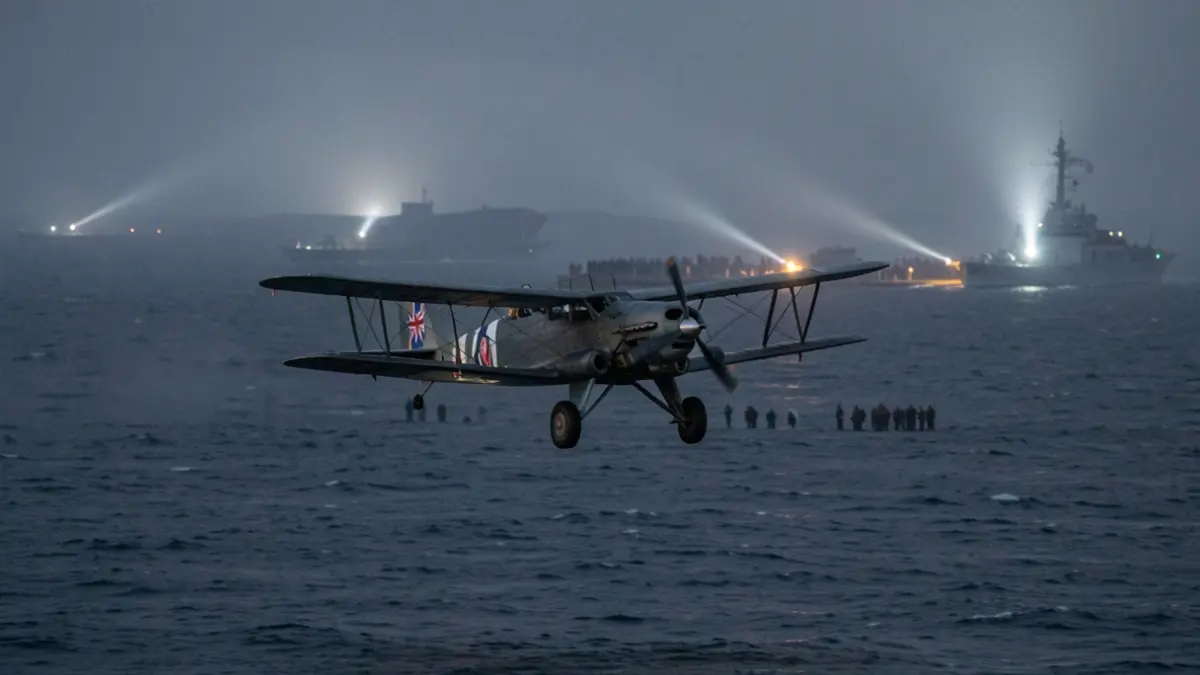
On the night of 11 November 1940, a small force of Fairey Swordfish aircraft took off from the flight deck of HMS Illustrious, heading towards the Italian naval base at Taranto. Six Italian battleships were anchored there, alongside other warships.
The operation, codenamed Operation Judgement, was originally planned for Trafalgar Day but was delayed. The Swordfish, with their fabric wings and open cockpits, appeared outdated but were effective torpedo bombers due to their ability to fly slowly and manoeuvre at low altitude.
The mission was exceptionally dangerous for the aircrews, who faced challenges including night flying, considerable distance, and a heavily defended harbour protected by anti-aircraft guns, barrage balloons, and torpedo nets. Their objective was to attack powerful Italian warships before returning to their carrier.
The Swordfish approached Taranto in two waves, with some carrying torpedoes and others bombs and flares. As the first aircraft arrived shortly before 11pm, Italian defences opened fire, while the Swordfish descended towards the anchored ships.
“"Of the 21 Swordfish launched, one turned back before reaching Taranto. Of the 20 that attacked, two were lost, with two airmen killed and two taken prisoner."
In return, the Fleet Air Arm disabled three of Italy's six battleships, including the Conte di Cavour, which never returned to operational service. The damage inflicted by such a small attacking force was remarkable, considering the risks faced by the crews.
The attack demonstrated that even a heavily defended naval harbour could not guarantee the safety of warships. Taranto challenged assumptions about naval base protection and highlighted the power of carrier-based aircraft, lessons that would become even more significant with the attack on Pearl Harbor a year later.
The contrast between the close-quarters naval warfare of 1805 at Trafalgar and the carrier-launched aircraft attack at Taranto 135 years later revealed how profoundly naval warfare had changed. The success still depended on the skill, determination, and courage of the men involved.
Discover more about the Fleet Air Arm at the Royal Navy Museums: Naval Aviation in Yeovilton, Somerset, where a Fairey Swordfish can be seen up close.