
“"I was delighted to share the findings of our project with healthcare professionals from across the region. By providing communication support to members of the Stroke Advisory Group with aphasia, we have empowered them to share insights that are often missed through standard patient feedback methods, enabling them to share ideas on how patients with aphasia can be better supported in acute and community settings. It has also given them the opportunity to express how research opportunities could be designed, so that their experiences can be taken into account when developing future services. I hope our findings highlight the importance of putting measures in place to give all stroke survivors a voice, enabling them to actively share their experiences to shape research and improve services for future patients."
NHS Trust Highlights Inclusive Research for Stroke Survivors with Aphasia
Maidstone Hospital's Stroke Advisory Group shares findings on empowering patients with communication needs in research and service development.
By Natalie Osborne
••3 min read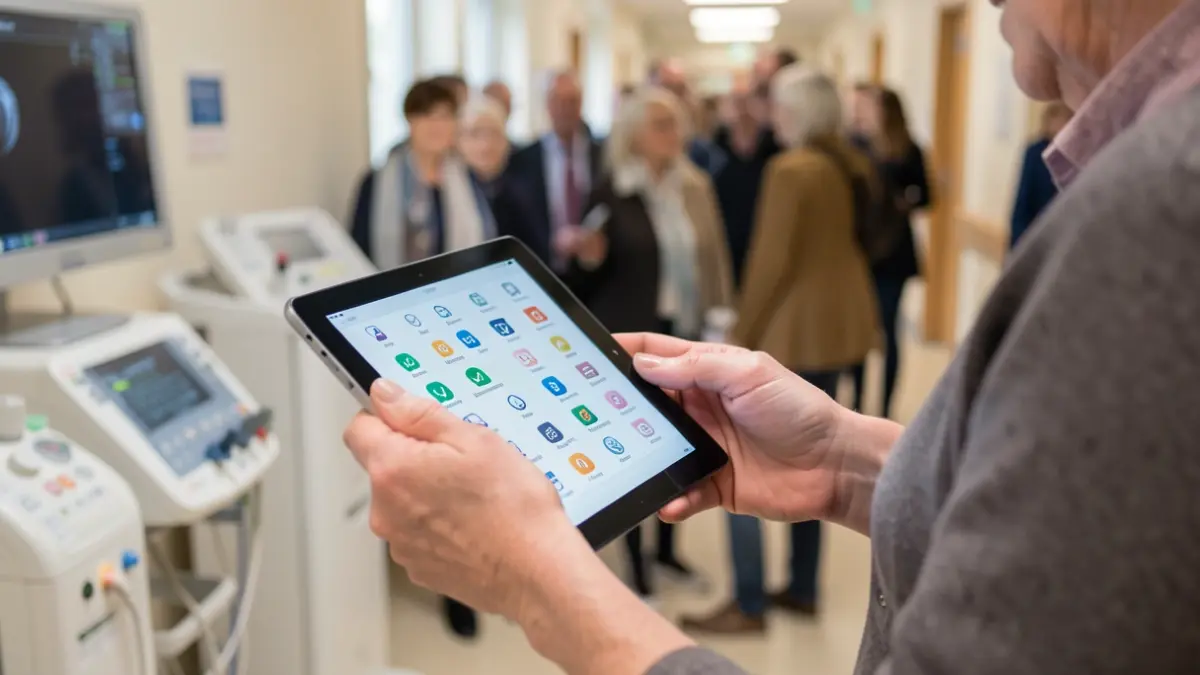
AI
Generic image of a speech and language therapist's hands holding a tablet with communication symbols.
Connie Poynter-Chard, Senior Speech and Language Therapist at Maidstone Hospital, presented findings on empowering stroke survivors with aphasia to participate in research and service development at the NIHR ARC KSS Research Week.
The Maidstone and Tunbridge Wells NHS Trust has highlighted its commitment to inclusive research, with Connie Poynter-Chard, Senior Speech and Language Therapist in the Stroke Unit at Maidstone Hospital, presenting key findings from the team’s Stroke Advisory Group project. The presentation took place at the National Institute for Health and Care Research (NIHR) Applied Research Collaboration Kent, Surrey and Sussex (ARC KSS) Research Week in September.
The symposium, themed ‘Advancing inclusive research: equity, partnership and participation in applied research’, was held at the University of Kent. It brought together healthcare professionals from across Kent, Surrey and Sussex to share learning and best practices. Poynter-Chard’s presentation focused on the Stroke Advisory Group’s efforts to ensure stroke survivors with aphasia can actively contribute to quality improvement projects and service development.
Aphasia, which affects approximately 30% of stroke survivors, can impair speech, reading, writing, and language comprehension. Standard patient engagement activities often exclude individuals with aphasia due to their communication needs, and less than a third of research studies are adapted to support their participation. The Stroke Advisory Group, composed of patients, family members, and carers who have experienced care at MTW, aims to shape stroke services by discussing service developments and research opportunities.
The group was specifically established to facilitate the full participation of stroke survivors with aphasia. Speech and language therapists attend each session, offering support and adapting communication methods using pictures, written information, and other accessible resources. This approach provides stroke survivors with aphasia the necessary space and time to voice their opinions on agenda items, service improvements, and research projects.
For further information about the Stroke Advisory Group and how to join, individuals can email mtw-tr.salt-stroke@nhs.net.
Based on information from the official source: Maidstone and Tunbridge Wells NHS Trust (04/11/2026)